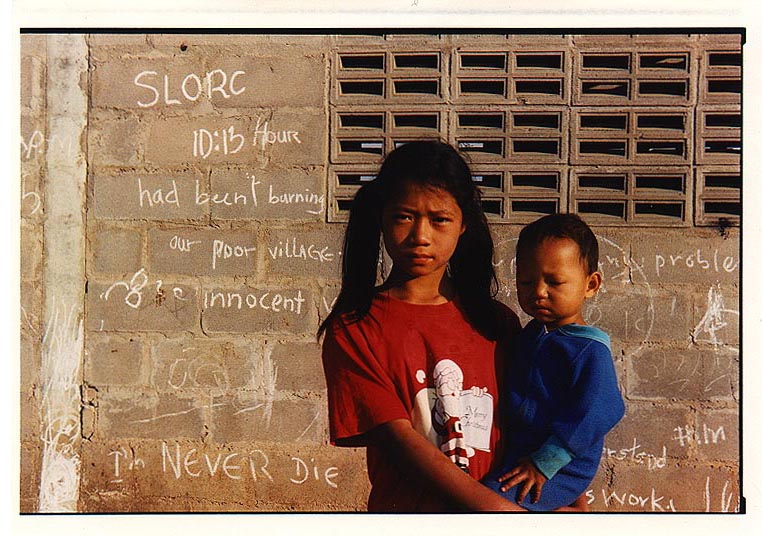
Children at the shell of the schoolhouse in Huay Ke Lok, a Karen refugee camp near Mae Sot, a few days after a cross-border attack by SLORC-supported guerrillas. (Click for full sized image)
|
|
Children at the shell of the schoolhouse in Huay Ke Lok, a Karen refugee camp near Mae Sot, a few days after a cross-border attack by SLORC-supported guerrillas. (Click for full sized image) |
"Up there is SLORC," said W, the Burmese rebel adjutant general in the passenger seat.
I looked out across the Moei River from Thailand into southern Burma, and peered up at a steep, jungle-covered mountain. I couldn't see any SLORC soldiers, so I pulled the truck over to get a better look. Several of the rebels and their family members hastily jumped out of the back--and headed for the bushes to relieve themselves. We had been driving for about three hours from Mae Sariang.The mountain was dark green, and brooding. I imagined its underbrush seething with SLORC troops. They would be small and hunched, with darting eyes, pointed ears and mangy orange hair. Certainly impossible to spot at this distance.
Chris DeBurgh was on the tape player. We cannot fight the power of the gun, to take away our land. They take it from our sons, swear it on my hands. My friend Tina had asked me to rent a truck in Chiang Mai and come visit her on the border. I told the rental place I was going trekking, and specifically needed a pickup truck. It made no sense at all, but they were satisfied. In fact, the idea was to drive a group of Burmese rebels down to Mae Sot, pick up food supplies and haul it all back to their camp on the Salween River.
As we continued south, W described where the SLORC had dotted the border with bases and artillery emplacements. He and the few thousand rebels in the student forces have been fighting the SLORC in zones along Burma's borders since 1988, when thousands of students fled from massacres in the capital.
I didn't call their attention to the song lyrics. The SLORC, having beefed up its forces to about 400,000 men, was rapidly taking over territory from the Karen National Union, which had been fighting for independence for 50 years and was allied with the smaller student force. Ethnic Karen refugees were fleeing across the border, swelling refugee camps in Thailand, and sometimes being harassed and attacked in Thailand by SLORC troops and Karen forces allied with SLORC.
The town of Mae Sot was a microcosm of the 50-year war. Its narrow streets were dotted with Burmese tea shops, and many stores were staffed by Karen refugees. Rice, potatoes and other staples were cheap in Mae Sot, where smuggled Burmese goods kept the prices low.
We dropped off two passengers at Dr. Cynthia's clinic, a ramshackle two-story building in which a staff of 50 gave free treatment to Karen refugees from the camps in the region. On the ground floor, low-ceilinged examination rooms were illuminated by daylight streaming throught gaps in the walls. The dirt floor was uneven, but well-swept. In a courtyard children were getting haircuts and what appeared to be de-lousing treatment.
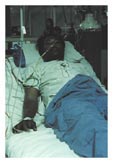 The most serious cases go to the Thai hospital in Mae Sot, which was willing to take them from Dr. Cynthia's because the clinic lightens the load on the hospital. That day, there were two extra cases: rebels injured in the fighting inside Burma.
Tun Tun, a student rebel, was hit in the stomach by shrapnel from an 81-mm shell as the KNU's 3rd Division was forced out of Sekhen Thit. Htoo R lay one row over, with blood seeping from his heavily bandaged foot. He's a Karen who has been fighting since 1988, when he was 18. Neither one had a lot to say to the foreigner, but M, a member of the same student group as Tun Tun, wanted me to take pictures. The Burmese discreetly formed a wall to block the Thai nurses from seeing the camera.
Arriving in Mae Sot, we distributed our passengers to a couple of different guesthouses, along the way picking up a tail in the form of an unmarked Thai police truck. But we shook them off after several quick turns. It seemed the coast was clear.
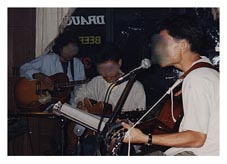 That night the rebels took the stage for a blues jam at Crocodile Tears, Mae Sot's answer to the Checkerboard Lounge. It's W, along with the student rebel representative in town, who is hobbled with a leg injury he got in battle years before. These guys are students. They like to play guitar and drink beers, in a bar. They might be fighting in the jungle most of the time, but this bar with its wooden tables, low ceiling, mixed Thai and Western crowd and cheap draft beer is as much their element.
The next day it was time to load the truck with provisions for the rebel camp. After a long and circuitous drive around town looking for a place to park that wouldn't be too obvious to the Thai police, Tina and I wandered around the market, and then the town. We bought a jacket for me--it's cold in the camp at night--and stationery for her to use in her English-teaching classes. And a Rod Stewart tape.
When we got back to the truck, MO, Tina's fiancé, and the others were ready to load up. A fellow with a bicycle cart came out of a storehouse with 50-kilo sacks of rice, "animal-feed" grade. Then 20-liter cans of cooking oil. Then 50-kilo sacks of potatoes and onions. Then bags of pickled tea leaves, beans, inexplicable vegetable nuggets (What are they? I love them).
By the time five or six loads came out, the truck was sagging on its springs. It was just inches off the ground. I looked at it doubtfully, and tried to rock it, but it wouldn't budge. There was no seeing out the back window of the cab. This was the load the truck was supposed to carry over the mountains and through river crossings, with who knows how many passengers on top.
(Later that day we found out that a protest was scheduled for the next morning at the Huay Ke Lok refugee camp, which had been partially burned down by DKBA attackers from across the border. We decided to go. At the crack of dawn we unloaded the ton and a half of supplies for the drive out to the camp. You can read my article about the protest.)
A few kilometers from town, the "Thai-Burmese Friendship Bridge" arched across the river. At least, most of it does, as construction on the modern span was halted in early 1995 in a dispute over some islands in the river. Newspaper reports said that negotiations between the new Thai government of Chavalit Yonchaiyudh and the SLORC could result in the bridge's completion. It's likely that much of its traffic will be made up of Karen refugees fleeing from the SLORC, unless they are caught by the Burmese regime or turned back by the Thais.
For the time being there was no bridge. A small road lined with shops led under the incomplete bridge and south along the Moei for a few hundred meters, to a dusty construction site where a new embankment for the river was underway. A tiny crooked pier a few planks wide reached out about a quarter of the way across the river. A wooden boat went back and forth from there to the muddy bank on the Burma side, while those who couldn't or wouldn't pay the fare simply waded across, carrying goods on their heads. Little kids, old women, nobody was stopping them. The Burmese village on the other side looked nice enough.
About ten kilometers outside of Mae Sariang, the dirt road was blocked by a red and white crossbar. On the left, at the bottom of a slope rising up to the left, was a small wooden guardhouse. Halted next to the house, before the gate, was a pickup truck. Its driver and passengers were off the truck, talking a group of men armed with semiautomatic rifles.
We headed for the gate, and I planned the smile and nod that would make the gate go up just fast enough that we wouldn't have to stop. One of the Thai police stepped out into the road, blocking our path.
The three Burmese students in the truck didn't have any papers, real or forged. They had been in Thai border prisons before. Conditions inside were harsh; they sometimes included beatings, or being forced to sit in the yard under the blazing tropical sun all day. They could be kept until enough bribe money was paid for their release--always with the possibility that they could be handed over to the SLORC in Burma, which would mean near-certain death, or perhaps years of imprisonment and worse. Borders create opportunity, and exploitation. The last time some of them were held there, it took a thousand dollars to get them out. One of them was MO.
Usually this checkpoint was a simple wave-through. Something was up, but we didn't know what it was. As we pulled over we agreed we were just travelers; we met these guys and agreed to help them transport food supplies, and we didn't ask where.
They ordered us out of the truck. The three or four Thai border police surrounded us, wearing street clothes and pistols. On the bank, near the guardhouse were a few more, in uniform, and with heavier weapons.
A thin Thai with a hard face asked Tina and me for our passports, or so we guessed, as he spoke no English. He looked over her New Zealand one and my US one, and handed hers back. The Burmese stayed in the back seat of the truck, and one of them started speaking with one of the police. Tina and I stood near the back of the truck, trying to look relaxed and casual, with a note of innocent concern, as in, "What could possibly be the matter, no doubt we'll be on our way in no time."
Another Thai, with a friendlier face and a black shirt, tried to speak with us while the other cops poked languidly through our cargo. Tina extracted a Thai-English phrase book. We tried to amuse him with inexpert pronunciations a few minutes of random phrases. Thumbing through the phrase, he stopped and pointed a phrase to us: "illegal immigrant." Much as I was impressed by how comprehensive the phrase book was, I would rather he hadn't pointed that one out.
Hard Face was giving the Burmese a hard time. They were alternately discussing and cajoling him, it sounded like, but it was made more difficult because none of the Thais knew Burmese, or vice versa. One Thai, however, knew Karen, and so did some of the Burmese. Since none of the Burmese who knew Karen knew English as well, Tina and I could find out only what trickled through the Thai-Karen-Burmese-English conduit.
The language barrier didn't stop us from understanding what happened next. Hard Face held up a photo he had found in the truck. In one, Tina stood on the shore of the Salween with MO. She wore fatigues and held an M-16.
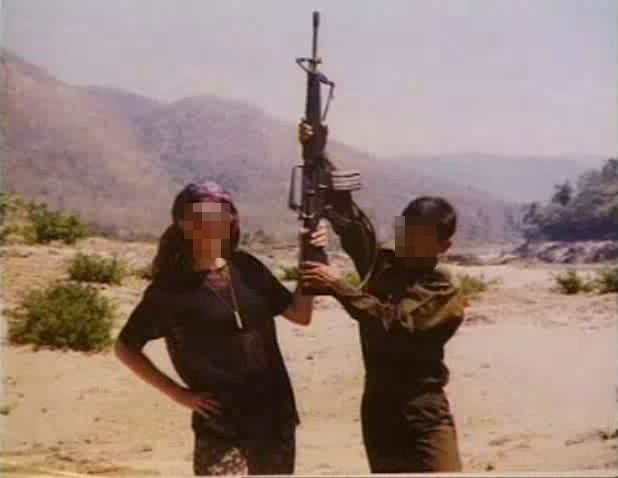
The innocent, helpful travelers story was seeming a bit less credible. It was becoming clear that the police knew exactly what was up. This was just preliminary negotiations for a heavy bribe--with luck.
Hard Face conferred for what seemed like a long while. Then he came back and assembled the linguistic conduit. Eventually we understood his proposal: We would all go back to Mae Sariang. All the Burmese and I would ride in one truck, with two of the cops. All the rest of the cops would go in the other truck, with Tina.
Tina looked at me with an unmistakeable expression. Absolutely not. Somehow in these situations one can make a simple concept clear if one is completely committed to it. For me, the concept was this: You would have to kill us all right now.
Hard Face reconsidered. Sigh of relief. Tina and I and two of the Burmese would go in our truck, driven by cops, everyone else in the other truck. This was better.
We started driving back along the bumpy road, taking a different route. Once again, Tina and I tried to joke around with our guards. We were deep in the forest when the radio crackled and an order came through.
Both trucks pulled over, off the road, into a small clearing, and stopped.
And then, nothing happened. We sat, sweating, in the truck. Waiting to be pulled out, and then what? A long while later, the radio crackled again. Our two cops got out of the truck, our Burmese friends came over and climbed onto the pile of food, and the cops drove away.
Over in the other truck, apparently, the Thai cops had told the Burmese all the things they were going to do to them, until they had separated the Burmese from every last baht they had. Weeks' worth of supply money for the camp had disappeared into the cops' pockets. But we were all safe, at least for now.
Heading back toward the Salween, we passed the checkpoint again. It was abandoned. The cops had better things to do now, back in town.
The road turned bumpier as it clambered over a series of ridges on the way toward the Salween. I picked my way around rocks and slogged through deep sand, and then we descended back to the forest.
Here the road follows, roughly, a tributary of the Salween. I say roughly, because as Tina pointed out, "it fords the river twenty-seven times" first. We would hurtle along the track, through the trees as we approached a ford, drop down the bank and plunge into the water at speed, so as not to get bogged down. The crossings were between ten and twenty meters wide, and the truck had no snorkel. It wasn't even four-wheel drive.
Each time we dove in, I scanned the other bank to pick out where the tracks emerged, aimed for that spot, and gunned it while the wheels scrabbled desperately at the rocky bottom. At one ford, the entire hood went under. River water surged up onto the windshield, and poured into the side window. But the engine never stopped, and we climbed out every time. All hail Isuzu (and a certain rental place in Chiang Mai, may they never know what we did to their truck).
Finally we reached a small cluster of houses on the bank of the Salween. Here we would leave the truck -- and my $1000 deposit -- to sit while we went by boat upriver to the camp. The Burmese, in their flip-flops, shouldered up these 50-kilo sacks and carried them quite easily down a precipice (made of sharp rocks, of course) and quickly loaded a longboat. And we set off on the Salween.
The longboat chugged upstream, swerving to avoid eddies in the fast-moving current. On the Thai side there were areas that had been logged, but for the most part the two banks looked similar -- forested hills rising steeply from the riverbanks. W spotted some wild geese on the Burmese side and we stopped off on a rocky promontory while he chase them. And Tina arranged some rocks on the shore to spell out FREEDOM. Or Victory? I can't remember.
The student rebel camp was impressively neat and organized. Wooden pipes carried water down from the hilltops. Walkways were lined with rocks, and young Burmese men, uniformly dressed in the pressed slacks and cotton shirts they favored in between tours of duty. Somehow it looked like a college campus.
And there were classes. They insisted I sketch on chalkboard the classic Internet cloud, the servers and routers, and explain http and other things that were barely known to most Americans at the time, let alone rebels living in the jungle miles from the nearest phone line.
I also gave a class on El Salvador, where the FMLN rebels and the allied popular movement had won a semi-favorable peace agreement after years of struggle. The Burmese were keenly interested in how they had accomplished this. I went through the factors that worked in favor of the rebels in El Salvador -- dependence on US aid, for one -- and as I did so I realized that none of them were operative for the Burmese.
Except to keep hoping, and keep struggling, as long as it takes.
And when the time has come, we'll reach out for the gun,
Taking back our land, take it for our sons...

You can find more travel stories...
 go to top of this page
e-mail me your comments